Title: RFTs Forecasts — Open-Method Live Console + Verifiable “Forecast Receipts” (Weather / Seismic / Magnetic / Solar)
Hey everyone  I’ve just pushed an update to my Space: RFTs Forecasts — a transparent, “show-your-work” live console that pulls public data in real time and labels near-term regime risk across four domains:
• Atmospheric (location-based, from Open-Meteo)
• Seismic (USGS event feed; either region mode or local-radius mode)
• Magnetic (global Kp, NOAA SWPC)
• Solar (global GOES X-ray flux, NOAA SWPC)
 What this is not
This is not a black-box predictor, not an NWP replacement, and not an earthquake time/epicenter predictor. It’s a live monitoring + decision-timing demo: explicit inputs → explicit intermediates → explicit rule → explicit label. If a feed is missing or too short, that domain is DISABLED instead of guessed.
 What’s different (why I built it)
Most “forecast” demos are hard to audit later. You can re-run them, but you can’t prove what happened at the time.
This Space now supports durable verification:
Forecast Receipts (tamper-evident history)
Every run can export a downloadable (receipt JSON)
that captures:
- exact source URLs + params + timestamps
- computed intermediates (z → τ_eff → index) and the rule fired
- environment snapshot (versions + constants)
- sha256 hashes of upstream payloads
- optional mode to embed raw upstream payloads (base64) for stronger offline verification
Receipt Upload Verification:
There’s also a Verify Receipt tab
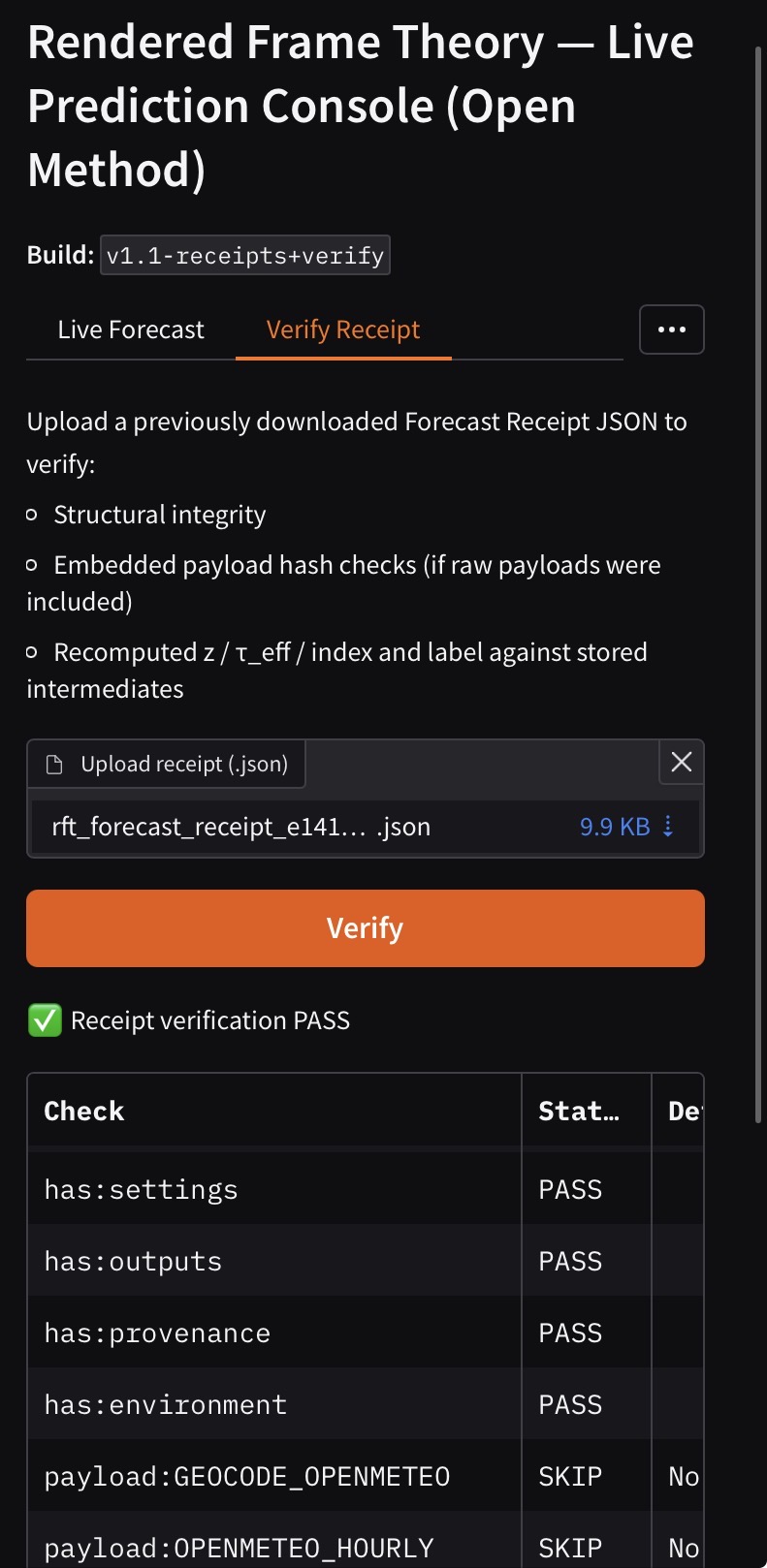
• validates the receipt structure
• verifies embedded payload hashes (if raw payloads were included)
• recomputes z / τ_eff / index / label from stored intermediates and checks it matches the recorded run
 Open method (simple, readable math)
Shared core:
• τ_eff = K · ln(1 + z)
• Ω_obs = 2π / T_earth
• Index = Ω_obs · τ_eff · α_R
Each domain defines z from a small set of bounded, inspectable features (ΔT, ΔP, quake count + max magnitude, Kp drift/slope, GOES flux mean/peak), then uses fixed thresholds to label the current regime.
I’d genuinely love feedback from people who care about reproducibility:
• Is the receipt format useful?
• What would make verification stronger / cleaner?
• Any UI or domain-scope improvements you’d want?