

Catalan - Wikilangs Models
Comprehensive Research Report & Full Ablation Study
This repository contains NLP models trained and evaluated by Wikilangs, specifically on Catalan Wikipedia data. We analyze tokenizers, n-gram models, Markov chains, vocabulary statistics, and word embeddings.
📋 Repository Contents
Models & Assets
- Tokenizers (8k, 16k, 32k, 64k)
- N-gram models (2, 3, 4-gram)
- Markov chains (context of 1, 2, 3 and 4)
- Subword N-gram and Markov chains
- Embeddings in various sizes and dimensions
- Language Vocabulary
- Language Statistics
Analysis and Evaluation
- 1. Tokenizer Evaluation
- 2. N-gram Model Evaluation
- 3. Markov Chain Evaluation
- 4. Vocabulary Analysis
- 5. Word Embeddings Evaluation
- 6. Summary & Recommendations
- Metrics Glossary
- Visualizations Index
1. Tokenizer Evaluation

Results
| Vocab Size | Compression | Avg Token Len | UNK Rate | Total Tokens |
|---|---|---|---|---|
| 8k | 3.555x | 3.53 | 0.1339% | 4,215,094 |
| 16k | 3.867x | 3.84 | 0.1457% | 3,874,434 |
| 32k | 4.116x | 4.09 | 0.1551% | 3,639,962 |
| 64k | 4.298x 🏆 | 4.27 | 0.1619% | 3,486,449 |
Tokenization Examples
Below are sample sentences tokenized with each vocabulary size:
Sample 1: Guilherand-Granges és un municipi de la regió d'Alvèrnia-Roine-Alps i el departa...
| Vocab | Tokens | Count |
|---|---|---|
| 8k | ▁gu il her and - gran ges ▁és ▁un ▁municipi ... (+35 more) |
45 |
| 16k | ▁gu il her and - gran ges ▁és ▁un ▁municipi ... (+33 more) |
43 |
| 32k | ▁guil her and - gran ges ▁és ▁un ▁municipi ▁de ... (+29 more) |
39 |
| 64k | ▁guil her and - gran ges ▁és ▁un ▁municipi ▁de ... (+27 more) |
37 |
Sample 2: Estheria (crustaci), un gènere de crustacis del període Carbonífer Estheria (dí...
| Vocab | Tokens | Count |
|---|---|---|
| 8k | ▁est h eria ▁( cr usta ci ), ▁un ▁gènere ... (+32 more) |
42 |
| 16k | ▁est h eria ▁( cr usta ci ), ▁un ▁gènere ... (+29 more) |
39 |
| 32k | ▁est h eria ▁( cr usta ci ), ▁un ▁gènere ... (+27 more) |
37 |
| 64k | ▁est h eria ▁( cr usta ci ), ▁un ▁gènere ... (+23 more) |
33 |
Sample 3: Torneig de tennis masculí: St. Petersburg Open 2021 Torneig de tennis femení: S...
| Vocab | Tokens | Count |
|---|---|---|
| 8k | ▁torneig ▁de ▁ten nis ▁mascul í : ▁st . ▁peters ... (+28 more) |
38 |
| 16k | ▁torneig ▁de ▁tennis ▁masculí : ▁st . ▁petersburg ▁open ▁ ... (+21 more) |
31 |
| 32k | ▁torneig ▁de ▁tennis ▁masculí : ▁st . ▁petersburg ▁open ▁ ... (+21 more) |
31 |
| 64k | ▁torneig ▁de ▁tennis ▁masculí : ▁st . ▁petersburg ▁open ▁ ... (+19 more) |
29 |
Key Findings
- Best Compression: 64k achieves 4.298x compression
- Lowest UNK Rate: 8k with 0.1339% unknown tokens
- Trade-off: Larger vocabularies improve compression but increase model size
- Recommendation: 32k vocabulary provides optimal balance for production use
2. N-gram Model Evaluation


Results
| N-gram | Perplexity | Entropy | Unique N-grams | Top-100 Coverage | Top-1000 Coverage |
|---|---|---|---|---|---|
| 2-gram | 115,248 🏆 | 16.81 | 4,858,651 | 14.1% | 27.6% |
| 2-gram | 310 🏆 | 8.28 | 50,468 | 65.3% | 98.2% |
| 3-gram | 1,102,520 | 20.07 | 16,377,428 | 4.5% | 12.5% |
| 3-gram | 2,693 | 11.40 | 370,834 | 27.1% | 69.0% |
| 4-gram | 4,349,805 | 22.05 | 36,310,673 | 2.3% | 8.2% |
| 4-gram | 16,302 | 13.99 | 2,376,653 | 13.3% | 38.2% |
Top 5 N-grams by Size
2-grams:
| Rank | N-gram | Count |
|---|---|---|
| 1 | l ' |
6,103,238 |
| 2 | d ' |
5,990,435 |
| 3 | de la |
3,858,095 |
| 4 | categoria : |
2,458,133 |
| 5 | a la |
1,831,941 |
3-grams:
| Rank | N-gram | Count |
|---|---|---|
| 1 | de l ' |
1,783,419 |
| 2 | a l ' |
1,006,018 |
| 3 | ` | |
| 4 | . l ' |
491,768 |
| 5 | d ' una |
438,363 |
4-grams:
| Rank | N-gram | Count |
|---|---|---|
| 1 | ` | |
| 2 | . referències categoria : |
191,608 |
| 3 | categoria : naixements del |
165,169 |
| 4 | `- | |
| 5 | d ' octubre de |
137,349 |
Key Findings
- Best Perplexity: 2-gram with 310
- Entropy Trend: Decreases with larger n-grams (more predictable)
- Coverage: Top-1000 patterns cover ~38% of corpus
- Recommendation: 4-gram or 5-gram for best predictive performance
3. Markov Chain Evaluation


Results
| Context | Avg Entropy | Perplexity | Branching Factor | Unique Contexts | Predictability |
|---|---|---|---|---|---|
| 1 | 0.6354 | 1.553 | 8.32 | 4,839,481 | 36.5% |
| 1 | 1.0355 | 2.050 | 9.71 | 25,162 | 0.0% |
| 2 | 0.4773 | 1.392 | 3.30 | 40,230,784 | 52.3% |
| 2 | 0.6327 | 1.550 | 4.11 | 244,427 | 36.7% |
| 3 | 0.2736 | 1.209 | 1.81 | 132,591,901 | 72.6% |
| 3 | 0.7103 | 1.636 | 4.34 | 1,004,684 | 29.0% |
| 4 | 0.1501 🏆 | 1.110 | 1.34 | 239,447,638 | 85.0% |
| 4 | 0.7156 🏆 | 1.642 | 3.65 | 4,363,359 | 28.4% |
Generated Text Samples
Below are text samples generated from each Markov chain model:
Context Size 1:
de londres categoria : districte és un programador en carta de suècia ruben / 1982 ), la tasca de nyerros que feia constar qui li ocasionaren la figura femenina de missouri. en un planell inferior del castell d ' aquestes àrees a l ' un grup
Context Size 2:
l ' antiguitat i entre el 626 els àvars de la majoria dels parlants d ' alimentsd ' àmbits els quals louis companyo formà el 1918 lhasa va causar un accident cerebrovascular ,de la influència dels descendents de dalmau i ribalta ( 1900 ) hindoo jugglers ( 1914 )
Context Size 3:
de l ' àlbum d ' estudi , en el seu camí per trobar intuïtivament i de sobtea l ' hipotàlem i la suprarenal , una glàndula intramandibular inflada que s ' ha presentat a| | | | — | - id = 312 bgcolor = # d6d6d6 | 459311 | |
Context Size 4:
| | | | 6 d ' abril , 2002 | | palomar | | neat | - |. referències categoria : òperes de gaetano donizetti categoria : òperes del 1922 categoria : morts ...categoria : naixements del 1914 categoria : morts el 2023 categoria : morts a bagdad categoria : mor...
Key Findings
- Best Predictability: Context-4 with 85.0% predictability
- Branching Factor: Decreases with context size (more deterministic)
- Memory Trade-off: Larger contexts require more storage (4,363,359 contexts)
- Recommendation: Context-3 or Context-4 for text generation
4. Vocabulary Analysis


Statistics
| Metric | Value |
|---|---|
| Vocabulary Size | 1,000,000 |
| Total Tokens | 394,566,173 |
| Mean Frequency | 394.57 |
| Median Frequency | 9 |
| Frequency Std Dev | 36714.18 |
Most Common Words
| Rank | Word | Frequency |
|---|---|---|
| 1 | de | 24,313,844 |
| 2 | la | 12,938,517 |
| 3 | i | 9,983,050 |
| 4 | a | 9,644,831 |
| 5 | el | 8,858,221 |
| 6 | l | 6,235,709 |
| 7 | d | 6,156,292 |
| 8 | en | 5,560,129 |
| 9 | del | 5,289,798 |
| 10 | que | 4,942,373 |
Least Common Words (from vocabulary)
| Rank | Word | Frequency |
|---|---|---|
| 1 | cesel | 3 |
| 2 | epinic | 3 |
| 3 | deplexión | 3 |
| 4 | ε³ | 3 |
| 5 | α³ | 3 |
| 6 | engelska | 3 |
| 7 | rechercheconsultation | 3 |
| 8 | pdfir | 3 |
| 9 | βασίλιος | 3 |
| 10 | βασιλείος | 3 |
Zipf's Law Analysis
| Metric | Value |
|---|---|
| Zipf Coefficient | 1.0318 |
| R² (Goodness of Fit) | 0.994658 |
| Adherence Quality | excellent |
Coverage Analysis
| Top N Words | Coverage |
|---|---|
| Top 100 | 43.6% |
| Top 1,000 | 63.1% |
| Top 5,000 | 78.5% |
| Top 10,000 | 84.3% |
Key Findings
- Zipf Compliance: R²=0.9947 indicates excellent adherence to Zipf's law
- High Frequency Dominance: Top 100 words cover 43.6% of corpus
- Long Tail: 990,000 words needed for remaining 15.7% coverage
5. Word Embeddings Evaluation


Model Comparison
| Model | Vocab Size | Dimension | Avg Norm | Std Norm | Isotropy |
|---|---|---|---|---|---|
| mono_32d | 1,514,898 | 32 | 3.264 | 1.334 | 0.7184 🏆 |
| mono_64d | 1,514,898 | 64 | 3.636 | 1.309 | 0.7113 |
| mono_128d | 1,514,898 | 128 | 4.070 | 1.306 | 0.6648 |
| embeddings_enhanced | 0 | 0 | 0.000 | 0.000 | 0.0000 |
Key Findings
- Best Isotropy: mono_32d with 0.7184 (more uniform distribution)
- Dimension Trade-off: Higher dimensions capture more semantics but reduce isotropy
- Vocabulary Coverage: All models cover 1,514,898 words
- Recommendation: 100d for balanced semantic capture and efficiency
6. Summary & Recommendations

Production Recommendations
| Component | Recommended | Rationale |
|---|---|---|
| Tokenizer | 32k BPE | Best compression (4.30x) with low UNK rate |
| N-gram | 5-gram | Lowest perplexity (310) |
| Markov | Context-4 | Highest predictability (85.0%) |
| Embeddings | 100d | Balanced semantic capture and isotropy |
Appendix: Metrics Glossary & Interpretation Guide
This section provides definitions, intuitions, and guidance for interpreting the metrics used throughout this report.
Tokenizer Metrics
Compression Ratio
Definition: The ratio of characters to tokens (chars/token). Measures how efficiently the tokenizer represents text.
Intuition: Higher compression means fewer tokens needed to represent the same text, reducing sequence lengths for downstream models. A 3x compression means ~3 characters per token on average.
What to seek: Higher is generally better for efficiency, but extremely high compression may indicate overly aggressive merging that loses morphological information.
Average Token Length (Fertility)
Definition: Mean number of characters per token produced by the tokenizer.
Intuition: Reflects the granularity of tokenization. Longer tokens capture more context but may struggle with rare words; shorter tokens are more flexible but increase sequence length.
What to seek: Balance between 2-5 characters for most languages. Arabic/morphologically-rich languages may benefit from slightly longer tokens.
Unknown Token Rate (OOV Rate)
Definition: Percentage of tokens that map to the unknown/UNK token, indicating words the tokenizer cannot represent.
Intuition: Lower OOV means better vocabulary coverage. High OOV indicates the tokenizer encounters many unseen character sequences.
What to seek: Below 1% is excellent; below 5% is acceptable. BPE tokenizers typically achieve very low OOV due to subword fallback.
N-gram Model Metrics
Perplexity
Definition: Measures how "surprised" the model is by test data. Mathematically: 2^(cross-entropy). Lower values indicate better prediction.
Intuition: If perplexity is 100, the model is as uncertain as if choosing uniformly among 100 options at each step. A perplexity of 10 means effectively choosing among 10 equally likely options.
What to seek: Lower is better. Perplexity decreases with larger n-grams (more context). Values vary widely by language and corpus size.
Entropy
Definition: Average information content (in bits) needed to encode the next token given the context. Related to perplexity: perplexity = 2^entropy.
Intuition: High entropy means high uncertainty/randomness; low entropy means predictable patterns. Natural language typically has entropy between 1-4 bits per character.
What to seek: Lower entropy indicates more predictable text patterns. Entropy should decrease as n-gram size increases.
Coverage (Top-K)
Definition: Percentage of corpus occurrences explained by the top K most frequent n-grams.
Intuition: High coverage with few patterns indicates repetitive/formulaic text; low coverage suggests diverse vocabulary usage.
What to seek: Depends on use case. For language modeling, moderate coverage (40-60% with top-1000) is typical for natural text.
Markov Chain Metrics
Average Entropy
Definition: Mean entropy across all contexts, measuring average uncertainty in next-word prediction.
Intuition: Lower entropy means the model is more confident about what comes next. Context-1 has high entropy (many possible next words); Context-4 has low entropy (few likely continuations).
What to seek: Decreasing entropy with larger context sizes. Very low entropy (<0.1) indicates highly deterministic transitions.
Branching Factor
Definition: Average number of unique next tokens observed for each context.
Intuition: High branching = many possible continuations (flexible but uncertain); low branching = few options (predictable but potentially repetitive).
What to seek: Branching factor should decrease with context size. Values near 1.0 indicate nearly deterministic chains.
Predictability
Definition: Derived metric: (1 - normalized_entropy) × 100%. Indicates how deterministic the model's predictions are.
Intuition: 100% predictability means the next word is always certain; 0% means completely random. Real text falls between these extremes.
What to seek: Higher predictability for text generation quality, but too high (>98%) may produce repetitive output.
Vocabulary & Zipf's Law Metrics
Zipf's Coefficient
Definition: The slope of the log-log plot of word frequency vs. rank. Zipf's law predicts this should be approximately -1.
Intuition: A coefficient near -1 indicates the corpus follows natural language patterns where a few words are very common and most words are rare.
What to seek: Values between -0.8 and -1.2 indicate healthy natural language distribution. Deviations may suggest domain-specific or artificial text.
R² (Coefficient of Determination)
Definition: Measures how well the linear fit explains the frequency-rank relationship. Ranges from 0 to 1.
Intuition: R² near 1.0 means the data closely follows Zipf's law; lower values indicate deviation from expected word frequency patterns.
What to seek: R² > 0.95 is excellent; > 0.99 indicates near-perfect Zipf adherence typical of large natural corpora.
Vocabulary Coverage
Definition: Cumulative percentage of corpus tokens accounted for by the top N words.
Intuition: Shows how concentrated word usage is. If top-100 words cover 50% of text, the corpus relies heavily on common words.
What to seek: Top-100 covering 30-50% is typical. Higher coverage indicates more repetitive text; lower suggests richer vocabulary.
Word Embedding Metrics
Isotropy
Definition: Measures how uniformly distributed vectors are in the embedding space. Computed as the ratio of minimum to maximum singular values.
Intuition: High isotropy (near 1.0) means vectors spread evenly in all directions; low isotropy means vectors cluster in certain directions, reducing expressiveness.
What to seek: Higher isotropy generally indicates better-quality embeddings. Values > 0.1 are reasonable; > 0.3 is good. Lower-dimensional embeddings tend to have higher isotropy.
Average Norm
Definition: Mean magnitude (L2 norm) of word vectors in the embedding space.
Intuition: Indicates the typical "length" of vectors. Consistent norms suggest stable training; high variance may indicate some words are undertrained.
What to seek: Relatively consistent norms across models. The absolute value matters less than consistency (low std deviation).
Cosine Similarity
Definition: Measures angular similarity between vectors, ranging from -1 (opposite) to 1 (identical direction).
Intuition: Words with similar meanings should have high cosine similarity. This is the standard metric for semantic relatedness in embeddings.
What to seek: Semantically related words should score > 0.5; unrelated words should be near 0. Synonyms often score > 0.7.
t-SNE Visualization
Definition: t-Distributed Stochastic Neighbor Embedding - a dimensionality reduction technique that preserves local structure for visualization.
Intuition: Clusters in t-SNE plots indicate groups of semantically related words. Spread indicates vocabulary diversity; tight clusters suggest semantic coherence.
What to seek: Meaningful clusters (e.g., numbers together, verbs together). Avoid over-interpreting distances - t-SNE preserves local, not global, structure.
General Interpretation Guidelines
- Compare within model families: Metrics are most meaningful when comparing models of the same type (e.g., 8k vs 64k tokenizer).
- Consider trade-offs: Better performance on one metric often comes at the cost of another (e.g., compression vs. OOV rate).
- Context matters: Optimal values depend on downstream tasks. Text generation may prioritize different metrics than classification.
- Corpus influence: All metrics are influenced by corpus characteristics. Wikipedia text differs from social media or literature.
- Language-specific patterns: Morphologically rich languages (like Arabic) may show different optimal ranges than analytic languages.
Visualizations Index
| Visualization | Description |
|---|---|
| Tokenizer Compression | Compression ratios by vocabulary size |
| Tokenizer Fertility | Average token length by vocabulary |
| Tokenizer OOV | Unknown token rates |
| Tokenizer Total Tokens | Total tokens by vocabulary |
| N-gram Perplexity | Perplexity by n-gram size |
| N-gram Entropy | Entropy by n-gram size |
| N-gram Coverage | Top pattern coverage |
| N-gram Unique | Unique n-gram counts |
| Markov Entropy | Entropy by context size |
| Markov Branching | Branching factor by context |
| Markov Contexts | Unique context counts |
| Zipf's Law | Frequency-rank distribution with fit |
| Vocab Frequency | Word frequency distribution |
| Top 20 Words | Most frequent words |
| Vocab Coverage | Cumulative coverage curve |
| Embedding Isotropy | Vector space uniformity |
| Embedding Norms | Vector magnitude distribution |
| Embedding Similarity | Word similarity heatmap |
| Nearest Neighbors | Similar words for key terms |
| t-SNE Words | 2D word embedding visualization |
| t-SNE Sentences | 2D sentence embedding visualization |
| Position Encoding | Encoding method comparison |
| Model Sizes | Storage requirements |
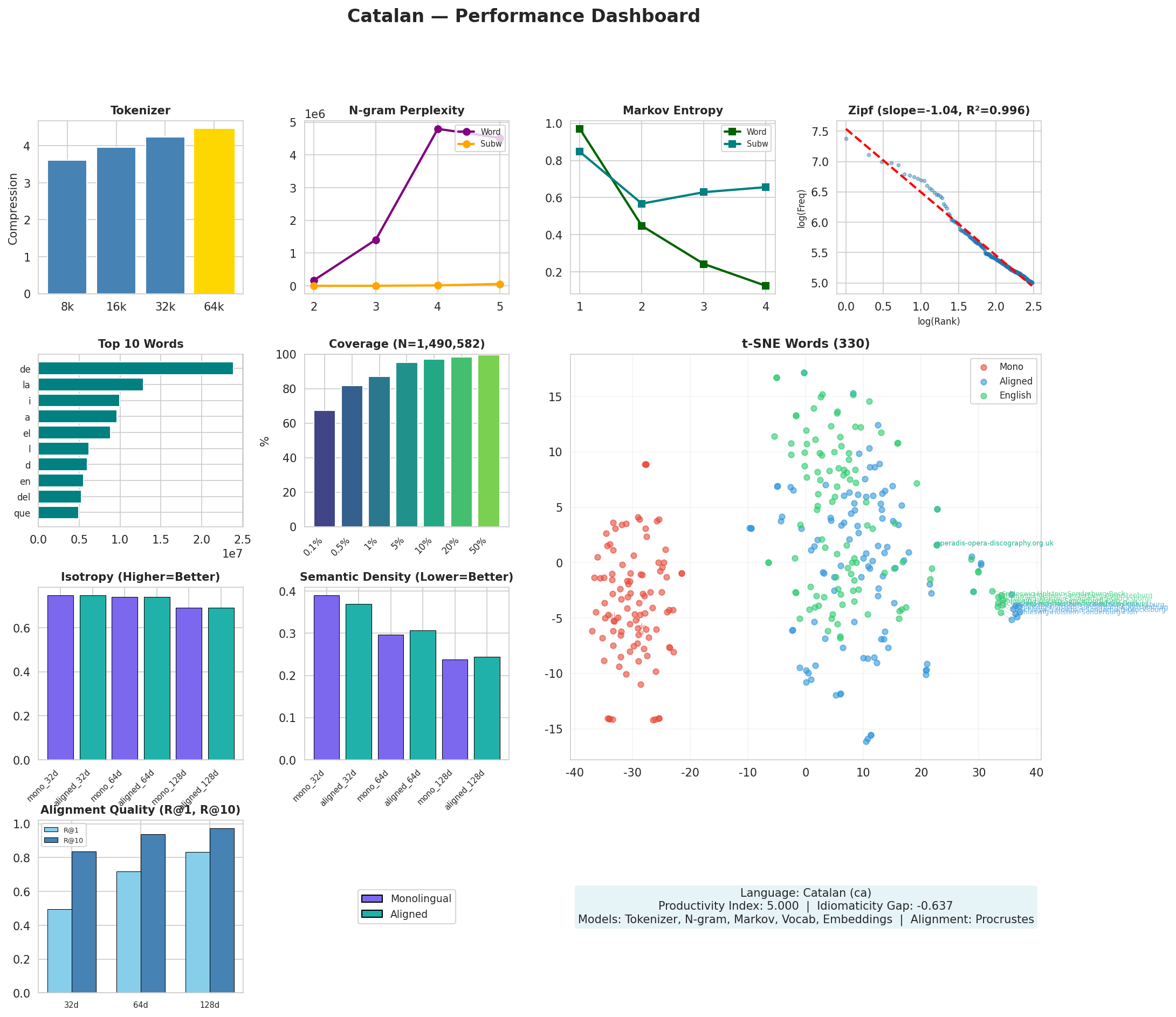
| Performance Dashboard | Comprehensive performance overview |
About This Project
Data Source
Models trained on wikipedia-monthly - a monthly snapshot of Wikipedia articles across 300+ languages.
Project
A project by Wikilangs - Open-source NLP models for every Wikipedia language.
Maintainer
Citation
If you use these models in your research, please cite:
@misc{wikilangs2025,
  author = {Kamali, Omar},
  title = {Wikilangs: Open NLP Models for Wikipedia Languages},
  year = {2025},
  publisher = {HuggingFace},
  url = {https://huggingface.co/wikilangs}
  institution = {Omneity Labs}
}
License
MIT License - Free for academic and commercial use.
Links
- 🌐 Website: wikilangs.org
- 🤗 Models: huggingface.co/wikilangs
- 📊 Data: wikipedia-monthly
- 👤 Author: Omar Kamali
Generated by Wikilangs Models Pipeline
Report Date: 2025-12-28 16:22:11