

CO - Wikilangs Models
Comprehensive Research Report & Full Ablation Study
This repository contains NLP models trained and evaluated by Wikilangs, specifically on CO Wikipedia data. We analyze tokenizers, n-gram models, Markov chains, vocabulary statistics, and word embeddings.
📋 Repository Contents
Models & Assets
- Tokenizers (8k, 16k, 32k, 64k)
- N-gram models (2, 3, 4-gram)
- Markov chains (context of 1, 2, 3 and 4)
- Subword N-gram and Markov chains
- Embeddings in various sizes and dimensions
- Language Vocabulary
- Language Statistics
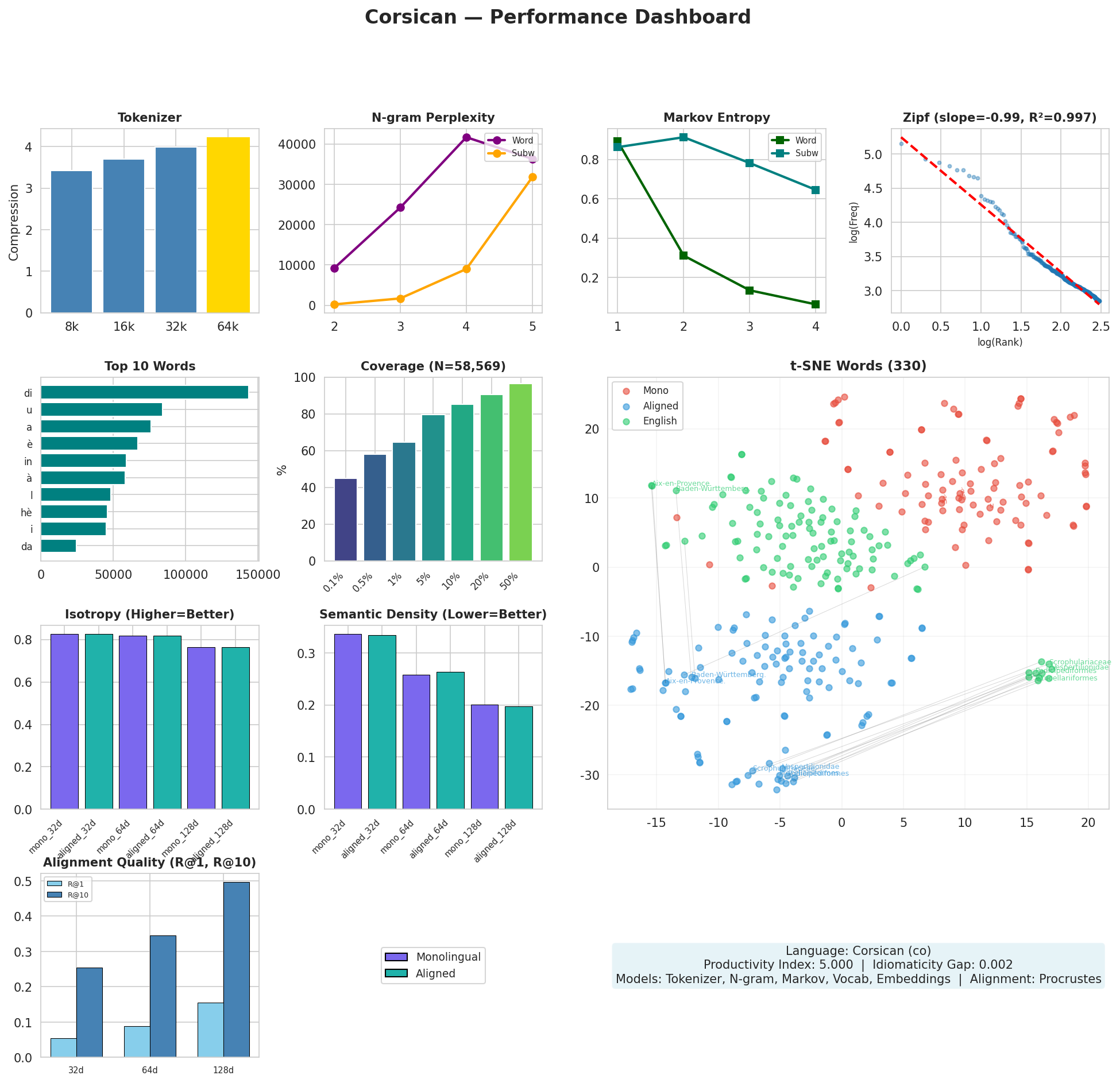
Analysis and Evaluation
- 1. Tokenizer Evaluation
- 2. N-gram Model Evaluation
- 3. Markov Chain Evaluation
- 4. Vocabulary Analysis
- 5. Word Embeddings Evaluation
- 6. Summary & Recommendations
- Metrics Glossary
- Visualizations Index
1. Tokenizer Evaluation

Results
| Vocab Size | Compression | Avg Token Len | UNK Rate | Total Tokens |
|---|---|---|---|---|
| 8k | 3.411x | 3.34 | 0.0362% | 381,463 |
| 16k | 3.668x | 3.59 | 0.0389% | 354,761 |
| 32k | 3.899x | 3.81 | 0.0414% | 333,726 |
| 64k | 4.112x 🏆 | 4.02 | 0.0436% | 316,458 |
Tokenization Examples
Below are sample sentences tokenized with each vocabulary size:
Sample 1: hè una cumuna spagnola di a pruvincia di Soria, in a cumunità autonoma di Castig...
| Vocab | Tokens | Count |
|---|---|---|
| 8k | ▁hè ▁una ▁cumuna ▁spagnola ▁di ▁a ▁pruvincia ▁di ▁soria , ... (+14 more) |
24 |
| 16k | ▁hè ▁una ▁cumuna ▁spagnola ▁di ▁a ▁pruvincia ▁di ▁soria , ... (+14 more) |
24 |
| 32k | ▁hè ▁una ▁cumuna ▁spagnola ▁di ▁a ▁pruvincia ▁di ▁soria , ... (+14 more) |
24 |
| 64k | ▁hè ▁una ▁cumuna ▁spagnola ▁di ▁a ▁pruvincia ▁di ▁soria , ... (+14 more) |
24 |
Sample 2: `Aries Spears hè un attore americanu.
Biugrafia
Da vede dinò Listinu di l'...`
| Vocab | Tokens | Count |
|---|---|---|
| 8k | ▁ari es ▁spe ars ▁hè ▁un ▁attore ▁americanu . ▁biugrafia ... (+22 more) |
32 |
| 16k | ▁ari es ▁spe ars ▁hè ▁un ▁attore ▁americanu . ▁biugrafia ... (+22 more) |
32 |
| 32k | ▁ari es ▁spe ars ▁hè ▁un ▁attore ▁americanu . ▁biugrafia ... (+22 more) |
32 |
| 64k | ▁aries ▁spears ▁hè ▁un ▁attore ▁americanu . ▁biugrafia ▁da ▁vede ... (+16 more) |
26 |
Sample 3: `Arliss Howard (18 ottobre 1954) hè un attore americanu.
Da vede dinò Listinu di...`
| Vocab | Tokens | Count |
|---|---|---|
| 8k | ▁ar li ss ▁ho ward ▁( 1 8 ▁ottobre ▁ ... (+23 more) |
33 |
| 16k | ▁ar li ss ▁ho ward ▁( 1 8 ▁ottobre ▁ ... (+23 more) |
33 |
| 32k | ▁ar li ss ▁howard ▁( 1 8 ▁ottobre ▁ 1 ... (+20 more) |
30 |
| 64k | ▁arli ss ▁howard ▁( 1 8 ▁ottobre ▁ 1 9 ... (+19 more) |
29 |
Key Findings
- Best Compression: 64k achieves 4.112x compression
- Lowest UNK Rate: 8k with 0.0362% unknown tokens
- Trade-off: Larger vocabularies improve compression but increase model size
- Recommendation: 32k vocabulary provides optimal balance for production use
2. N-gram Model Evaluation


Results
| N-gram | Perplexity | Entropy | Unique N-grams | Top-100 Coverage | Top-1000 Coverage |
|---|---|---|---|---|---|
| 2-gram | 8,586 🏆 | 13.07 | 59,847 | 24.1% | 47.7% |
| 2-gram | 252 🏆 | 7.98 | 3,720 | 68.2% | 99.4% |
| 3-gram | 25,561 | 14.64 | 108,167 | 12.3% | 31.9% |
| 3-gram | 1,976 | 10.95 | 27,040 | 26.7% | 74.8% |
| 4-gram | 50,965 | 15.64 | 187,731 | 9.1% | 24.8% |
| 4-gram | 10,378 | 13.34 | 132,259 | 13.2% | 40.9% |
Top 5 N-grams by Size
2-grams:
| Rank | N-gram | Count |
|---|---|---|
| 1 | l ' |
45,334 |
| 2 | di u |
18,690 |
| 3 | di a |
18,510 |
| 4 | d ' |
14,383 |
| 5 | di l |
13,245 |
3-grams:
| Rank | N-gram | Count |
|---|---|---|
| 1 | di l ' |
12,757 |
| 2 | à l ' |
5,757 |
| 3 | a famiglia di |
4,354 |
| 4 | hè una spezia |
3,364 |
| 5 | com ' è |
3,225 |
4-grams:
| Rank | N-gram | Count |
|---|---|---|
| 1 | di a famiglia di |
2,632 |
| 2 | a famiglia di i |
2,171 |
| 3 | hè una spezia di |
2,067 |
| 4 | à wikimedia commons . |
1,947 |
| 5 | annantu à wikimedia commons |
1,947 |
Key Findings
- Best Perplexity: 2-gram with 252
- Entropy Trend: Decreases with larger n-grams (more predictable)
- Coverage: Top-1000 patterns cover ~41% of corpus
- Recommendation: 4-gram or 5-gram for best predictive performance
3. Markov Chain Evaluation


Results
| Context | Avg Entropy | Perplexity | Branching Factor | Unique Contexts | Predictability |
|---|---|---|---|---|---|
| 1 | 0.8152 | 1.760 | 5.44 | 128,497 | 18.5% |
| 1 | 1.0047 | 2.007 | 7.61 | 1,338 | 0.0% |
| 2 | 0.3514 | 1.276 | 1.95 | 698,773 | 64.9% |
| 2 | 0.9540 | 1.937 | 5.63 | 10,183 | 4.6% |
| 3 | 0.1551 | 1.114 | 1.31 | 1,359,938 | 84.5% |
| 3 | 0.8234 | 1.770 | 4.05 | 57,282 | 17.7% |
| 4 | 0.0762 🏆 | 1.054 | 1.13 | 1,780,901 | 92.4% |
| 4 | 0.6487 🏆 | 1.568 | 2.82 | 232,155 | 35.1% |
Generated Text Samples
Below are text samples generated from each Markov chain model:
Context Size 1:
di l ' edda l ' uparatori devi u rè unificadori , u rodanu è à, i bordi di a so pusizioni giugrafica . mentri chì và , ti pristaraghju u. a so nomu di a femina face di a prima u primu piannu fundata u
Context Size 2:
l ' esemplare più grossu mai truvatu fubbe tumbatu in angola in u mediterraniu . faci partidi u cubu di u 2011 , airbnb hà raccoltu $ 119 , 8 % in isuzudi a nutazioni pusiziunali micca assà diffarenti rispettu à l ' animali chì si pò mintuvà :
Context Size 3:
di l ' arte è di a fine di listessu annu deposita à l ' iranu . porphyrioà l ' università di versailles , hè cunnisciutu sottu u nome di locu vicinu di u vechjua famiglia di e liliaceae . descrizzione lucalisazione referenze ligami categoria : cumuna di corsic...
Context Size 4:
di a famiglia di i ranunculaceae . discrizzioni ranunculus kuepferi hè una spezia di acellu chì face...a famiglia di i laniidae , chì cumprende dinù altre spezie d ' aythya . si ciba per uhè una spezia di acellu chì face parte di a famiglia di i polypodiaceae . ' ssa pianta priferisce
Key Findings
- Best Predictability: Context-4 with 92.4% predictability
- Branching Factor: Decreases with context size (more deterministic)
- Memory Trade-off: Larger contexts require more storage (232,155 contexts)
- Recommendation: Context-3 or Context-4 for text generation
4. Vocabulary Analysis


Statistics
| Metric | Value |
|---|---|
| Vocabulary Size | 60,410 |
| Total Tokens | 2,262,071 |
| Mean Frequency | 37.45 |
| Median Frequency | 4 |
| Frequency Std Dev | 967.51 |
Most Common Words
| Rank | Word | Frequency |
|---|---|---|
| 1 | di | 143,631 |
| 2 | u | 84,326 |
| 3 | a | 76,229 |
| 4 | è | 67,228 |
| 5 | in | 58,950 |
| 6 | à | 58,500 |
| 7 | l | 48,443 |
| 8 | hè | 46,128 |
| 9 | i | 45,172 |
| 10 | da | 24,646 |
Least Common Words (from vocabulary)
| Rank | Word | Frequency |
|---|---|---|
| 1 | corsehttps | 2 |
| 2 | secchia | 2 |
| 3 | bergeries | 2 |
| 4 | douleur | 2 |
| 5 | bouvier | 2 |
| 6 | spezialità | 2 |
| 7 | alerta | 2 |
| 8 | francebleu | 2 |
| 9 | emissions | 2 |
| 10 | ꦈꦠꦩ | 2 |
Zipf's Law Analysis
| Metric | Value |
|---|---|
| Zipf Coefficient | 1.0521 |
| R² (Goodness of Fit) | 0.997001 |
| Adherence Quality | excellent |
Coverage Analysis
| Top N Words | Coverage |
|---|---|
| Top 100 | 48.2% |
| Top 1,000 | 68.9% |
| Top 5,000 | 83.6% |
| Top 10,000 | 89.1% |
Key Findings
- Zipf Compliance: R²=0.9970 indicates excellent adherence to Zipf's law
- High Frequency Dominance: Top 100 words cover 48.2% of corpus
- Long Tail: 50,410 words needed for remaining 10.9% coverage
5. Word Embeddings Evaluation


Model Comparison
| Model | Vocab Size | Dimension | Avg Norm | Std Norm | Isotropy |
|---|---|---|---|---|---|
| mono_32d | 32,860 | 32 | 4.128 | 1.155 | 0.8279 🏆 |
| mono_64d | 32,860 | 64 | 4.723 | 1.023 | 0.8160 |
| mono_128d | 32,860 | 128 | 5.374 | 0.857 | 0.7544 |
| embeddings_enhanced | 0 | 0 | 0.000 | 0.000 | 0.0000 |
Key Findings
- Best Isotropy: mono_32d with 0.8279 (more uniform distribution)
- Dimension Trade-off: Higher dimensions capture more semantics but reduce isotropy
- Vocabulary Coverage: All models cover 32,860 words
- Recommendation: 100d for balanced semantic capture and efficiency
6. Summary & Recommendations

Production Recommendations
| Component | Recommended | Rationale |
|---|---|---|
| Tokenizer | 32k BPE | Best compression (4.11x) with low UNK rate |
| N-gram | 5-gram | Lowest perplexity (252) |
| Markov | Context-4 | Highest predictability (92.4%) |
| Embeddings | 100d | Balanced semantic capture and isotropy |
Appendix: Metrics Glossary & Interpretation Guide
This section provides definitions, intuitions, and guidance for interpreting the metrics used throughout this report.
Tokenizer Metrics
Compression Ratio
Definition: The ratio of characters to tokens (chars/token). Measures how efficiently the tokenizer represents text.
Intuition: Higher compression means fewer tokens needed to represent the same text, reducing sequence lengths for downstream models. A 3x compression means ~3 characters per token on average.
What to seek: Higher is generally better for efficiency, but extremely high compression may indicate overly aggressive merging that loses morphological information.
Average Token Length (Fertility)
Definition: Mean number of characters per token produced by the tokenizer.
Intuition: Reflects the granularity of tokenization. Longer tokens capture more context but may struggle with rare words; shorter tokens are more flexible but increase sequence length.
What to seek: Balance between 2-5 characters for most languages. Arabic/morphologically-rich languages may benefit from slightly longer tokens.
Unknown Token Rate (OOV Rate)
Definition: Percentage of tokens that map to the unknown/UNK token, indicating words the tokenizer cannot represent.
Intuition: Lower OOV means better vocabulary coverage. High OOV indicates the tokenizer encounters many unseen character sequences.
What to seek: Below 1% is excellent; below 5% is acceptable. BPE tokenizers typically achieve very low OOV due to subword fallback.
N-gram Model Metrics
Perplexity
Definition: Measures how "surprised" the model is by test data. Mathematically: 2^(cross-entropy). Lower values indicate better prediction.
Intuition: If perplexity is 100, the model is as uncertain as if choosing uniformly among 100 options at each step. A perplexity of 10 means effectively choosing among 10 equally likely options.
What to seek: Lower is better. Perplexity decreases with larger n-grams (more context). Values vary widely by language and corpus size.
Entropy
Definition: Average information content (in bits) needed to encode the next token given the context. Related to perplexity: perplexity = 2^entropy.
Intuition: High entropy means high uncertainty/randomness; low entropy means predictable patterns. Natural language typically has entropy between 1-4 bits per character.
What to seek: Lower entropy indicates more predictable text patterns. Entropy should decrease as n-gram size increases.
Coverage (Top-K)
Definition: Percentage of corpus occurrences explained by the top K most frequent n-grams.
Intuition: High coverage with few patterns indicates repetitive/formulaic text; low coverage suggests diverse vocabulary usage.
What to seek: Depends on use case. For language modeling, moderate coverage (40-60% with top-1000) is typical for natural text.
Markov Chain Metrics
Average Entropy
Definition: Mean entropy across all contexts, measuring average uncertainty in next-word prediction.
Intuition: Lower entropy means the model is more confident about what comes next. Context-1 has high entropy (many possible next words); Context-4 has low entropy (few likely continuations).
What to seek: Decreasing entropy with larger context sizes. Very low entropy (<0.1) indicates highly deterministic transitions.
Branching Factor
Definition: Average number of unique next tokens observed for each context.
Intuition: High branching = many possible continuations (flexible but uncertain); low branching = few options (predictable but potentially repetitive).
What to seek: Branching factor should decrease with context size. Values near 1.0 indicate nearly deterministic chains.
Predictability
Definition: Derived metric: (1 - normalized_entropy) × 100%. Indicates how deterministic the model's predictions are.
Intuition: 100% predictability means the next word is always certain; 0% means completely random. Real text falls between these extremes.
What to seek: Higher predictability for text generation quality, but too high (>98%) may produce repetitive output.
Vocabulary & Zipf's Law Metrics
Zipf's Coefficient
Definition: The slope of the log-log plot of word frequency vs. rank. Zipf's law predicts this should be approximately -1.
Intuition: A coefficient near -1 indicates the corpus follows natural language patterns where a few words are very common and most words are rare.
What to seek: Values between -0.8 and -1.2 indicate healthy natural language distribution. Deviations may suggest domain-specific or artificial text.
R² (Coefficient of Determination)
Definition: Measures how well the linear fit explains the frequency-rank relationship. Ranges from 0 to 1.
Intuition: R² near 1.0 means the data closely follows Zipf's law; lower values indicate deviation from expected word frequency patterns.
What to seek: R² > 0.95 is excellent; > 0.99 indicates near-perfect Zipf adherence typical of large natural corpora.
Vocabulary Coverage
Definition: Cumulative percentage of corpus tokens accounted for by the top N words.
Intuition: Shows how concentrated word usage is. If top-100 words cover 50% of text, the corpus relies heavily on common words.
What to seek: Top-100 covering 30-50% is typical. Higher coverage indicates more repetitive text; lower suggests richer vocabulary.
Word Embedding Metrics
Isotropy
Definition: Measures how uniformly distributed vectors are in the embedding space. Computed as the ratio of minimum to maximum singular values.
Intuition: High isotropy (near 1.0) means vectors spread evenly in all directions; low isotropy means vectors cluster in certain directions, reducing expressiveness.
What to seek: Higher isotropy generally indicates better-quality embeddings. Values > 0.1 are reasonable; > 0.3 is good. Lower-dimensional embeddings tend to have higher isotropy.
Average Norm
Definition: Mean magnitude (L2 norm) of word vectors in the embedding space.
Intuition: Indicates the typical "length" of vectors. Consistent norms suggest stable training; high variance may indicate some words are undertrained.
What to seek: Relatively consistent norms across models. The absolute value matters less than consistency (low std deviation).
Cosine Similarity
Definition: Measures angular similarity between vectors, ranging from -1 (opposite) to 1 (identical direction).
Intuition: Words with similar meanings should have high cosine similarity. This is the standard metric for semantic relatedness in embeddings.
What to seek: Semantically related words should score > 0.5; unrelated words should be near 0. Synonyms often score > 0.7.
t-SNE Visualization
Definition: t-Distributed Stochastic Neighbor Embedding - a dimensionality reduction technique that preserves local structure for visualization.
Intuition: Clusters in t-SNE plots indicate groups of semantically related words. Spread indicates vocabulary diversity; tight clusters suggest semantic coherence.
What to seek: Meaningful clusters (e.g., numbers together, verbs together). Avoid over-interpreting distances - t-SNE preserves local, not global, structure.
General Interpretation Guidelines
- Compare within model families: Metrics are most meaningful when comparing models of the same type (e.g., 8k vs 64k tokenizer).
- Consider trade-offs: Better performance on one metric often comes at the cost of another (e.g., compression vs. OOV rate).
- Context matters: Optimal values depend on downstream tasks. Text generation may prioritize different metrics than classification.
- Corpus influence: All metrics are influenced by corpus characteristics. Wikipedia text differs from social media or literature.
- Language-specific patterns: Morphologically rich languages (like Arabic) may show different optimal ranges than analytic languages.
Visualizations Index
| Visualization | Description |
|---|---|
| Tokenizer Compression | Compression ratios by vocabulary size |
| Tokenizer Fertility | Average token length by vocabulary |
| Tokenizer OOV | Unknown token rates |
| Tokenizer Total Tokens | Total tokens by vocabulary |
| N-gram Perplexity | Perplexity by n-gram size |
| N-gram Entropy | Entropy by n-gram size |
| N-gram Coverage | Top pattern coverage |
| N-gram Unique | Unique n-gram counts |
| Markov Entropy | Entropy by context size |
| Markov Branching | Branching factor by context |
| Markov Contexts | Unique context counts |
| Zipf's Law | Frequency-rank distribution with fit |
| Vocab Frequency | Word frequency distribution |
| Top 20 Words | Most frequent words |
| Vocab Coverage | Cumulative coverage curve |
| Embedding Isotropy | Vector space uniformity |
| Embedding Norms | Vector magnitude distribution |
| Embedding Similarity | Word similarity heatmap |
| Nearest Neighbors | Similar words for key terms |
| t-SNE Words | 2D word embedding visualization |
| t-SNE Sentences | 2D sentence embedding visualization |
| Position Encoding | Encoding method comparison |
| Model Sizes | Storage requirements |
| Performance Dashboard | Comprehensive performance overview |
About This Project
Data Source
Models trained on wikipedia-monthly - a monthly snapshot of Wikipedia articles across 300+ languages.
Project
A project by Wikilangs - Open-source NLP models for every Wikipedia language.
Maintainer
Citation
If you use these models in your research, please cite:
@misc{wikilangs2025,
  author = {Kamali, Omar},
  title = {Wikilangs: Open NLP Models for Wikipedia Languages},
  year = {2025},
  publisher = {HuggingFace},
  url = {https://huggingface.co/wikilangs}
  institution = {Omneity Labs}
}
License
MIT License - Free for academic and commercial use.
Links
- 🌐 Website: wikilangs.org
- 🤗 Models: huggingface.co/wikilangs
- 📊 Data: wikipedia-monthly
- 👤 Author: Omar Kamali
Generated by Wikilangs Models Pipeline
Report Date: 2025-12-28 23:12:11